
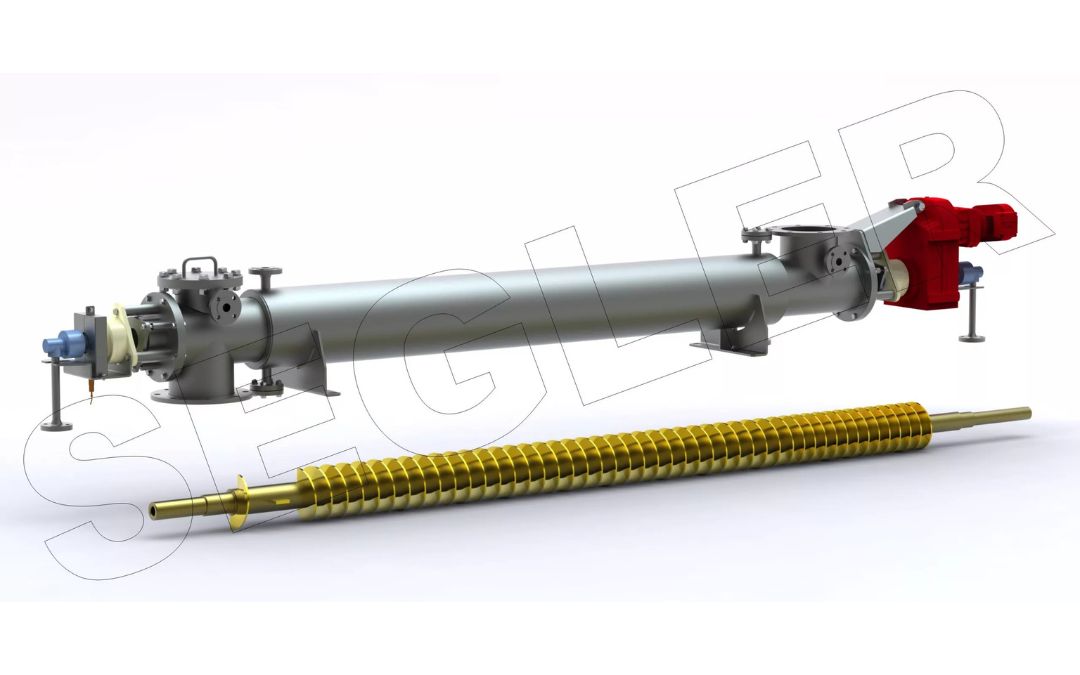
Whether in the food industry, the chemical industry, in recycling or in heavy plant construction: when it comes to reliable material transport, the screw conveyors the undisputed centerpiece of countless process engineering systems.
But what makes this technology so indispensable? A screw conveyor - often referred to in technical jargon as a screw conveyor or Transport screws is far more than just a simple means of transportation. It is a highly complex solution for the Continuous promotion, dosing and even the thermal treatment of demanding bulk solids. In this guide, you will learn how to overcome typical challenges such as wear, dust emissions or complex dosing processes with the right conveyor technology can be solved sustainably.
Why screw conveyors are so versatile: Areas of application & product protection
The Bulk material conveying often presents system operators with major challenges. Different material properties require adaptable systems. Screw conveyors are characterized here by their enormous flexibility:
- Classic bulk goods: Smooth transportation of the finest powders, granulates, pellets and chips.
- Sophisticated media: Reliable handling of sticky sewage sludge, moist pastes or highly abrasive scale.
- Recycling & disposal: Safe handling of shredded plastics, filter cake or sawdust.
- Special applications: Even cryogenic transport (e.g. frozen bacterial cultures from liquid nitrogen) can be realized without any problems.

Closed system for maximum environmental and occupational safety
Dust and odor emissions are a massive pain point in the industry. Modern screw conveyors operate as a completely closed system. They are dust-, water- and optionally even gas-tight. This means
- Product protection: The conveyed goods are protected from external contamination such as moisture or dirt.
- Environmental protection: Employees and the plant are effectively protected from harmful dusts, toxic gases or unpleasant odors - a decisive factor in complying with strict environmental regulations.
Precise dosing and high energy efficiency
The industrial Material transportation requires not only movement, but above all precision and efficiency.
Volumetrically precise dosing screws
Complex and error-prone pre-dosing devices can often be dispensed with if the screw conveyor itself takes over the dosing. As the screw speed is directly proportional to the feed rate, screw feeders are suitable for dosing screws perfect for the precise feeding of reactors, mixers or filling systems. This significantly simplifies the process setup.
Cost-effectiveness compared to pneumatic systems
Screw conveyors score particularly highly in terms of energy costs thanks to their very high efficiency. The power is transferred directly from the drive to the conveyed material - with minimal slippage. In contrast to pneumatic systems, which have to compress huge volumes of air in an energy-intensive manner, screw conveyors consume significantly less electricity per ton conveyed. This reduces operating costs and improves your CO2 balance. You also benefit from a durable, low-maintenance design, as primarily only the shaft runs in the product and there are no wear-prone chain links (as with chain conveyors).
Highest standards: Hygiene, safety and extreme operating conditions
Process engineering processes know no compromises when it comes to safety. Screw conveyors must therefore be designed to be robust and comply with standards.
- Explosion protection (ATEX): Screw conveyors can be certified for use in potentially explosive areas up to zone 20 (dust Ex) or zone 0 (gas Ex) - including economical nitrogen inerting.
- Food & pharma: For sensitive industries, finely ground product contact surfaces, FDA-compliant PTFE seals and screwless, product-contact zones (TSE/BSE and ADI-free) are realized.
- Pressure and heat resistance: For thermal processes (e.g. as ash cooling screws), systems for continuous operating temperatures of up to +850 °C design. In addition, pressure-tight (up to +1.0 bar) and pressure shock-resistant versions (up to 15 bar) guarantee absolute system safety.
- Wear protection: Abrasive media require special measures, such as cost-effective hardfacing or WCR hardfaced worm shafts.
Customized designs for specific processes
Often, transportation alone is not enough. The geometry of the screw flights can be modified to fulfill additional process-related tasks.
- Window thread: Recesses in the sash prevent bridging, break up clumping and ensure continuous self-cleaning.
- Paddle thread: Adjustable paddles on the shaft mix the material intensively during transportation.
- Tempering screws (hollow blades): A temperature control medium (water, thermal oil, steam) is passed through hollow shafts or blades. This allows the material to be heated or cooled directly during transportation.
- External thread serration: Acts like a scraper and keeps the trough clean even with pasty, highly adhesive substances.
- Multi-shaft technology: For extreme conveying volumes or materials with a strong tendency to bridge, two or more screws interlock. They clean each other and achieve conveying capacities in the three- to four-digit cubic meter range per hour.


Typical application examples in practice
- Silo discharge augers (without pre-dosing)
- Sand washing classifiers and floating sinking stages in the recycling industry
- Scale transportation in the harsh environment of steelworks
- Safe transportation of frozen bacterial cultures for yoghurt production
- Reliable ash discharge in thermal recycling plants
Conclusion: Your partner for customized conveyor technology
Screw conveyors are the backbone of efficient, safe and low-maintenance production systems. Whether standard material transport or highly complex, temperature-controlled dosing tasks under ATEX conditions: The key to success lies in the precise, system-specific design of the components.
Rely on proven engineering:
Developed for over 100 years SEGLER In mechanical engineering, we offer customized, extremely durable solutions that are precisely tailored to your conveyed goods and your process requirements.
Do you have a special conveying problem or are you planning a new system?
Contact us now and get advice!