
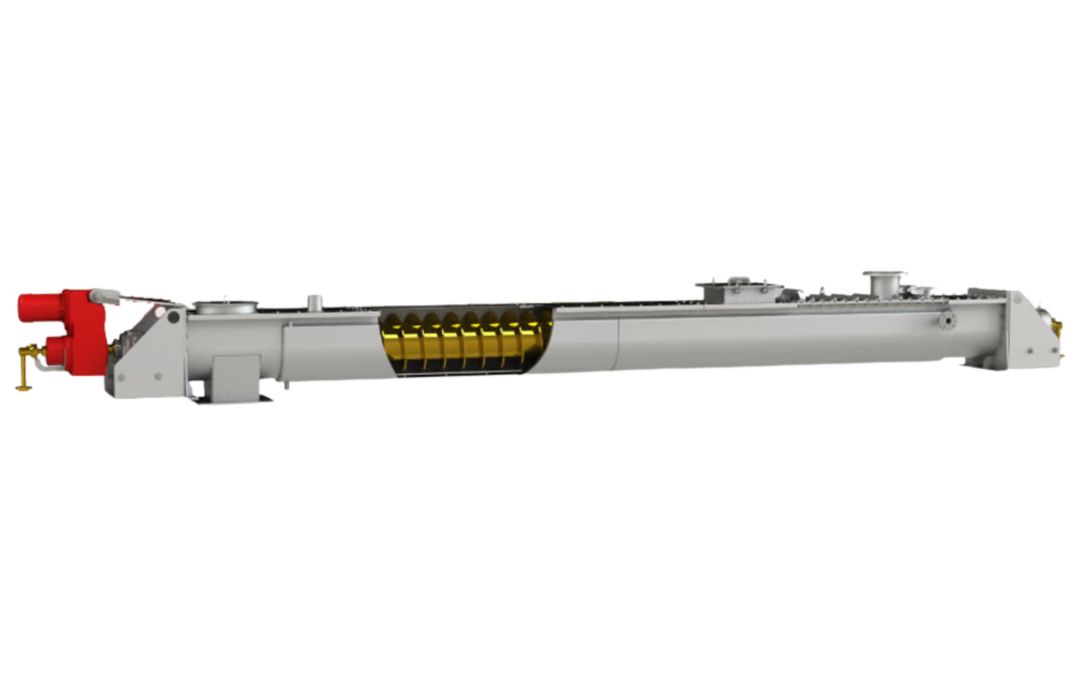
A screw heat exchanger combines two tasks in one machine: it conveys bulk materials, slurries, or pastes and heats or cools them at the same time. The component can operate as a cooling screw, a heating screw, or a continuous tempering section, thus often replacing a combination of a conveyor, heat exchanger, and mixer. In this guide, you will learn how a screw heat exchanger works technically, which designs and heat transfer fluids are available, and in which industries the heating or cooling screw shows its strengths.
What is a spiral heat exchanger?
A screw heat exchanger, also called a thermal screw or thermal screw conveyor, is a screw conveyor with an integrated heat transfer surface. As the bulk material moves through the trough, a heat transfer medium flows in parallel through hollow components of the screw. Through direct contact with the metal surfaces, heat is either introduced into the product (heating screw) or removed from the product (cooling screw). The process is indirect, meaning the product and the heat transfer medium do not come into contact with each other.
Key Features of a Screw Heat Exchanger at a Glance:
- Cooling coil Removal of heat from hot bulk materials such as bed ash, granules, salts, or reaction products
- Heating screw Heating of powders, pastes, or slurries for reaction control, conditioning, or pre-drying
- Temperature control: Constant process temperature over the entire conveying distance
- Additional features: Mixing, Dosing, Sanitizing, Self-cleaning, or Loosening in one step
Heat exchanger screw, thermal screw conveyor, cooling screw conveyor, and heating screw conveyor all describe the same operating principle. In English, the term screw heat exchanger common.
Operating Principle: How a Screw Heat Exchanger Works
Heat transfer occurs through three possible contact surfaces:
- Screw shaft (hollow shaft) The heat transfer medium flows through the central tube of the screw. This variant is often sufficient for small temperature differences or small mass flows.
- Screw conveyor (hollow thread / thermal flight): The helix is designed with a double wall and is flowed through by the heat transfer medium. Since the screw blades form the largest product-contacting surface per meter of conveying distance, the transmission capacity increases significantly.
- Trench and trench cover (double jacket): For high performance requirements, the housing and cover are also temperature-controlled. This creates a closed heat exchange surface around the entire bulk material.
Depending on the requirements, plant manufacturers combine these three surfaces individually or together. With generous design, screw heat exchangers achieve fill levels of up to 90 percent and thus a very good surface-area-to-volume ratio. This is a key advantage over conventional plate heat exchangers or fluidized bed coolers: screw heat exchangers require significantly less installation space.
Heat transfer fluids
The medium used depends on the target temperature, the bulk material, and the existing infrastructure. Common options include:
- Water or water-glycol mixture: for moderate cooling tasks up to about 90 °C
- Water vapor for direct heating in the low-pressure range
- Heat transfer fluid for higher temperatures far exceeding 300°C, for both cooling hot products and for heating
- Nitrogen or other gases: in inert processes, for example with explosive dusts
- Electric heating mats or heating cartridges: for applications without a separate heat transfer fluid circuit
Designs: Single-wall, double-wall, and special designs
Screw heat exchangers come in various designs, which are adapted to the properties of bulk materials and process requirements:
- Single-layer execution: Standard for free-flowing bulk materials such as granules, powders, or granular products. Compact, robust, easy to maintain.
- Two-wave (combing) design: For paste-like, sticky, or baking media. The intermeshing shafts clean each other and prevent adhesion on the heat exchange surfaces.
- Self-cleaning constructions: With a recessed thread or modified wing geometry that prevents bridging and insulating layers.
- Pressure-tight and gas-tight constructions: For inert atmospheres, pressure operation, or ATEX zones.
Design Options for SEGLER
SEGLER's spiral heat exchangers can be configured in the following variants:
- Thread design Full thread, relief thread with mixed or self-cleaning effect, hollow thread
- Features: Thermo wings, trough tempering, armor plating, wear plates, coatings, cleaning openings, CIP connection, inspection hatches, rotation monitor, level indicators, multiple feed and discharge points
- Specifications dustproof, gas-tight, pressure-tight or pressure-shock resistant
Advantages of Screw Heat Exchangers at a Glance
A heating or cooling screw combines several process steps in one machine. This offers concrete advantages for operators:
- Two processes in one step: Conveying and temperature control run in parallel. Separate heat exchangers and additional conveying lines are eliminated.
- Minimal space requirement High heat exchange surface per meter of conveying path, closed design.
- Efficient heat recovery: The heat transfer medium circulates in a closed loop and can be connected to other process locations.
- Closed System Dust, water, and, if desired, gas-tight. Protects the product from contamination and personnel from emissions.
- Long service life: Robust materials, low-wear construction, few moving parts.
- Additional procedural steps can be integrated Mixing, Dosing, Pasteurizing, Drying.
- Gentle Produktbehandlung Indirect heat transfer without direct contact between the heat transfer medium and the bulk material.
- Uniform temperature control Reproducible process results through defined dwell time.
Fields of application: In which industries do helical heat exchangers work
SEGLER supplies screw heat exchangers for four key industries. While the requirements vary significantly, the basic principle remains the same.
Chemistry
In the chemical industry, screw heat exchangers, specifically cooling screws, are an integral part of many processes. Typical applications include:
- Cooling hot reaction products before further processing
- Gas cooler for solid crystallization, for example in the production of melamine from hot gas streams
- Bed ash removal from fluidized bed reactors with product temperatures well above 300 °C
- Tempering of salts, pigments, and specialty chemicals
- Inert operation with gas-tight design and ATEX-compliant design for areas with gas or dust explosion hazards
Corrosive and abrasive media are contained through material selection, coatings, and cladding.
Groceries
In the food industry, the heating screw performs tasks such as hygienizing, conditioning, and controlled heating of powders, granules, or pastes. A cooling screw, for example, is used after drying or baking processes to bring the product to storage temperature before packaging. The construction meets the requirements of Hygienic Design:
- Stainless steel on all product-contact surfaces
- Finely ground surfaces to minimize adhesion
- FDA-compliant PTFE seals, TSE/BSE and ADI-free
- No product-contacting screws or bearings, no dead spaces
- CIP-capable construction for in-place cleaning
Energy and Environment
In the energy and environmental sectors, cooling screws are primarily used for the removal and temperature control of hot residual materials: bed ash and fly ash from incineration plants, pyrolysis products, or residues from thermal recovery processes. Heating screws, in turn, are used for the pre-drying of sewage sludge and similar sludges, as well as for process steps in biomass and alternative fuel processing. The robust design can withstand high temperatures and abrasive media.
Raw and basic materials
In the case of mineral raw materials, fertilizers, salts, or building materials, screw heat exchangers are used for controlled temperature management downstream of reactors, dryers, or mills. Here, too, the screw heat exchanger replaces the in-line arrangement of a conveyor and a heat exchanger, reducing the footprint in the process.
Design: What counts when planning a heating or cooling screw
An economic design is based on empirical procedures, supported by thermodynamic calculations and tests with the original bulk material. The following input parameters determine the design and size:
- Bulk material type (free-flowing, cohesive, pasty, abrasive, corrosive)
- Mass flow rate and desired residence time
- Inlet and outlet temperature of the product
- Available heat transfer medium and its flow temperature
- Required heating power in kW
- Pressure and leak tightness, ATEX requirements
- Cleaning and hygiene requirements
- Spatial constraints at the installation site
On this basis, screw diameters, pitch, rotational speed, material, and heat exchange surface area are dimensioned. For critical bulk materials, a test in the technical center is recommended to realistically evaluate heat transfer coefficients and adhesion behavior.
Frequently Asked Questions about Shell and Tube Heat Exchangers
Mechanically, both machines are identically constructed. The difference lies solely in their function: a cooling screw removes heat from the bulk material, while a heating screw adds heat. The same machine can be operated in both directions via the heat transfer medium and its flow temperature.
Free-flowing powders, granules, salts, ashes, and pellets are suitable, as are pasty, sticky, or difficult-to-flow media. For the latter, twin-shaft, self-cleaning designs are usually used. Very moist bulk solids for pure drying are a borderline case, as the temperature difference often becomes too small to achieve drying economically.
The range extends from low-temperature applications and classic process temperatures to very hot products. For cooling, inlet temperatures of several hundred degrees Celsius are common, and with appropriate design, even significantly higher. For heating, heat transfer fluid supply temperatures exceeding 300°C are used.
Water, water-glycol mixtures, water vapor, thermal oil, inert gases, and electric heating. The choice depends on the target temperature, safety requirements, and available supply technology.
Yes. For inert atmospheres or potentially explosive environments, gas-tight and pressure-tight versions are manufactured, complemented by ATEX-compliant design and corresponding shaft seals.
The geometry of snail wings allows for mixing, loosening, dosing, self-cleaning, or sanitizing to be integrated into the conveying process. This often means a single machine replaces an entire process line.
Conclusion
A screw heat exchanger is the right choice when bulk solids, sludge, or paste need to be conveyed and tempered simultaneously. As a cooling screw, it reliably removes process heat; as a heating screw, it introduces defined amounts of heat, and as a tempering section, it maintains products at the target temperature along the entire conveying length. The combination of indirect heat transfer, a closed system, and a compact design makes the heating and cooling screw a central component in the chemical, food, energy, and environmental industries, as well as the raw and basic materials industries. The most effective way to determine the appropriate design, material, and heat exchange surface for individual cases is in a specific engineering discussion with the system manufacturer.
Are you planning a thermal conveying task? SEGLER designs and manufactures screw heat exchangers tailored to bulk materials, heat transfer fluids, and process environments. Please contact us with your design specifications; together we will find the right heating or cooling screw for your application.
More on this on our Product page.